How to choose between cash back, points, and miles
Learn how cashback, points, and miles work, what the most common mistakes are, and which system offers the most value for your profile.
Cash back or miles? Understand the differences before choosing your card

Choosing the right credit card rewards program sounds simple, until you realize that two cards with the same “2% rewards” headline can deliver completely different real-world value.
Some people save hundreds of dollars a year with cash back. Others unlock luxury flights worth thousands through travel miles.
And many cardholders end up earning rewards they barely use because they picked the wrong system for their lifestyle.
By the end, you’ll know exactly which type of rewards card makes the most sense for your financial goals, instead of simply choosing the card with the flashiest marketing.
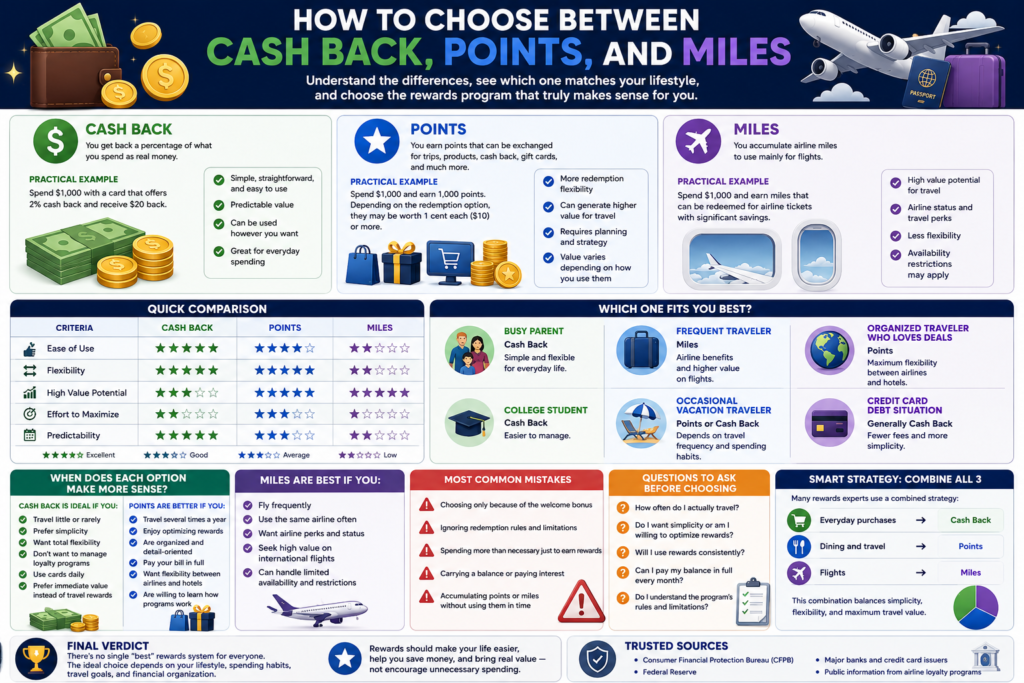
What is the difference between cash back, points, and miles?
At a basic level, all three reward systems give you something back for your spending.
The major difference is how flexible the rewards are and how much effort is required to maximize their value.
| Reward Type | How It Works | Best For | Main Advantage | Main Drawback |
|---|---|---|---|---|
| Cash Back | Earn a percentage of spending back as money | Everyday users | Simple and flexible | Lower maximum upside |
| Points | Earn points redeemable in various ways | Flexible spenders | Multiple redemption options | Can become confusing |
| Miles | Earn travel-focused airline rewards | Frequent travelers | High-value travel potential | Limited flexibility |
Understanding this distinction is important because many people choose rewards based on emotion rather than usability.
Travel rewards often sound more luxurious, but simplicity frequently produces better long-term value for average consumers.
How cash back rewards work
Cash back is the most straightforward rewards structure available.
You spend money on your card and receive a percentage of that spending back as a statement credit, bank deposit, check, or sometimes gift card.
For example:
- Spend $1,000 with a 2% cash back card
- Earn $20 back
That’s it.
There are usually no complicated redemption charts, transfer partners, or fluctuating values.
Why cash back is so popular
Cash back appeals to people who value predictability and simplicity.
According to data from the Consumer Financial Protection Bureau (CFPB) and major U.S. card issuers, many consumers fail to fully redeem travel rewards or use them inefficiently.
Cash back avoids that issue because the value is clear from the beginning.
For many households, cash back also aligns better with financial priorities such as:
- Reducing monthly expenses
- Paying bills
- Building emergency savings
- Offsetting inflation
- Avoiding unnecessary spending
Instead of chasing aspirational travel, cash back creates immediate financial utility.
When cash back usually makes more sense
Cash back often works best if you:
- Rarely travel;
- Prefer simplicity;
- Want flexible rewards;
- Dislike managing loyalty programs;
- Spend heavily on groceries, gas, utilities, and daily expenses;
- Want rewards you can use immediately;
- Carry a balance occasionally.
Travel rewards cards often have high interest rates and annual fees.
If someone carries debt from month to month, interest charges can quickly outweigh the value of points or miles.
In those situations, a simple no-annual-fee cash back card is often financially smarter.
Why some people prefer points
Points programs are popular because they combine flexibility with optimization potential.
Unlike airline-specific miles, flexible points ecosystems allow users to move rewards between airlines and hotels.
This creates opportunities for much higher redemption value.
For example, a traveler redeeming points strategically through airline transfer partners may get significantly more value compared to redeeming the same points for statement credits.
This is why experienced travel enthusiasts often prefer points over basic miles.
How airline miles work
Miles are generally tied to specific airline loyalty programs. Unlike flexible points, airline miles are usually designed primarily for flights and travel-related redemptions.
You earn miles through:
- Airline credit cards
- Flight purchases
- Airline partners
- Hotel and travel spending
The major advantage of miles is the potential for high-value travel experiences, especially international or premium cabin flights.
Real-world comparison: Which reward type gives more value?
The answer depends entirely on behavior. Here’s a practical comparison:
| User Profile | Best Option | Why |
|---|---|---|
| Busy parent managing household expenses | Cash back | Simplicity and flexibility |
| Frequent business traveler | Miles | Airline perks and flight value |
| Organized traveler who enjoys optimization | Points | Maximum redemption flexibility |
| College student building credit | Cash back | Easier to manage |
| Occasional vacation traveler | Points or cash back | Depends on travel frequency |
| Someone carrying credit card debt | Usually cash back | Lower fees and simpler structure |
Final verdict: which one should you choose?
The best choice depends on how you spend, travel, organize finances, and use rewards in real life.
Choose cash back if you value simplicity, flexibility, and predictable savings.
Most importantly, remember that rewards should support your financial life, not complicate it.
A rewards program is only valuable if it aligns with your habits, helps you save money, and avoids pushing you into unnecessary spending or debt.
The smartest rewards strategy is rarely the flashiest one. It’s the one you’ll actually use consistently and responsibly over time.
Related content
Cosigner vs. Co-Borrower
Compare cosigner vs. co-borrower and discover which alternative is safer for personal loans.
Keep reading * You will remain on the current website