Investing in dollars: 7 mistakes that cause thousands of beginners to enter too late
Learn the essential steps to start investing in dollars safely, consistently, and with long-term goals in mind.
Warning: You may be losing money waiting for the “right time” to invest in dollars
For many Americans, Investing in dollars sounds simple. After all, the U.S. dollar is already the world’s reserve currency, and dollar-based investments are everywhere.
Some spend years trying to “time the market.” Others believe they need a large amount of money before investing. Many simply freeze during periods of inflation, economic uncertainty, or market volatility.
The result is often the same: they enter the market late, miss years of compound growth, and struggle to build long-term wealth.
This guide explains the 7 biggest mistakes beginners make when Investing in dollars, and how to avoid them before they cost you years of financial growth.
Why so many beginners delay Investing in dollars
Most new investors are not losing money because they made catastrophic decisions. They lose opportunities because they hesitate.
This hesitation usually comes from three factors:
| Common Fear | What Happens in Practice |
|---|---|
| Fear of investing at the wrong time | Investors wait indefinitely for a “market crash” |
| Fear of losing money | Cash sits idle while inflation reduces purchasing power |
| Lack of knowledge | Beginners postpone investing until they “feel ready” |
The irony is that delaying can become more expensive than starting imperfectly.
For example, the U.S. inflation rate significantly increased between 2021 and 2023, according to the U.S. Bureau of Labor Statistics.
During high inflation periods, money held only in cash loses purchasing power over time.
That’s why understanding beginner mistakes is critical before making financial decisions.
Mistake #1: Waiting for the “perfect moment” to invest
This is arguably the most common beginner mistake in Investing in dollars.
Many people believe they should wait for:
- lower interest rates;
- a stock market correction;
- a recession;
- political stability;
- lower inflation;
- or a “better entry point.”
In reality, nobody consistently predicts markets accurately. Even professional fund managers struggle to time the market over long periods.
Research from companies like Vanguard repeatedly shows that “time in the market” tends to outperform “timing the market” for long-term investors.
Why this mistake becomes dangerous
While beginners wait:
- markets may continue rising;
- dividends are missed;
- compound growth is delayed;
- inflation keeps reducing cash value.
A person who starts investing consistently at 25 may end up with significantly more wealth than someone who waits until 35, even if the second person invests larger amounts later.
What works better instead
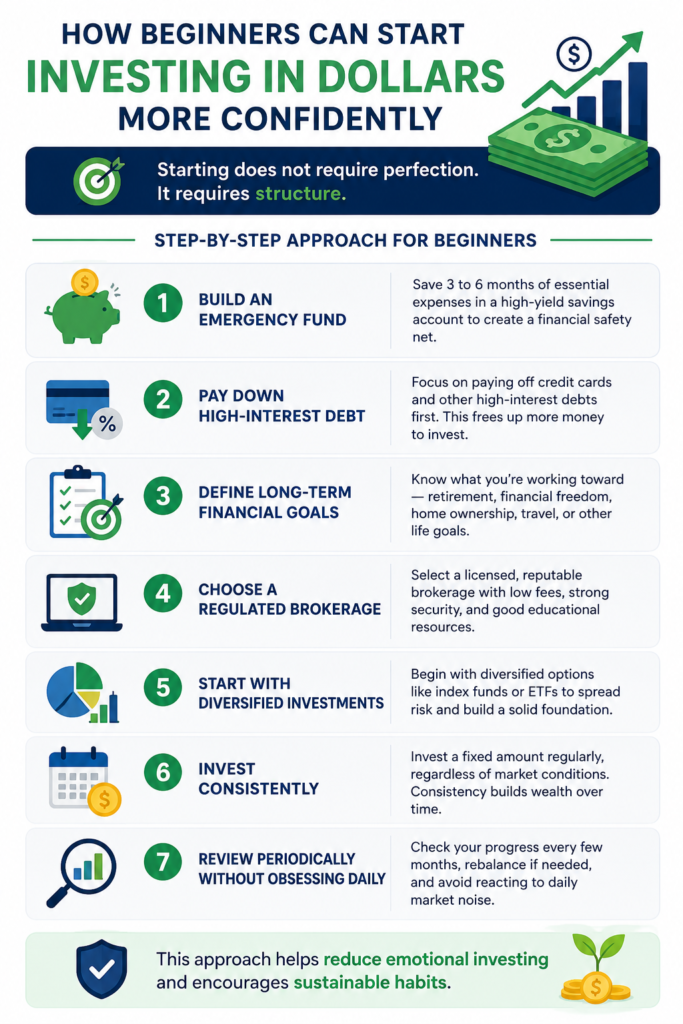
Many long-term investors use dollar-cost averaging (DCA). This strategy means investing fixed amounts regularly regardless of market conditions.
Instead of trying to predict the best day to invest, investors focus on consistency over time.
Mistake #2: Believing you need a lot of money to start
Another major barrier in Investing in dollars is the belief that investing is only for wealthy people.
This misconception causes many beginners to postpone investing for years.
In reality, many modern brokerages allow:
- fractional shares;
- commission-free trades;
- automated investing;
- low minimum balances.
Today, beginners can start investing with relatively small amounts.
How this mindset hurts beginners
Waiting to accumulate a large lump sum delays exposure to:
- compound interest;
- dividend reinvestment;
- market experience;
- financial education through practice.
Small but consistent contributions often matter more than large but delayed investments.
Example of long-term impact
| Monthly Investment | Estimated Annual Return | Approximate Value After 20 Years |
|---|---|---|
| $100 | 7% | ~$52,000 |
| $300 | 7% | ~$156,000 |
| $500 | 7% | ~$260,000 |
These examples are hypothetical and not guaranteed, but they illustrate how consistency can compound over time.
Mistake #3: Keeping too much money in cash during inflation
Holding emergency savings is important. Holding excessive idle cash for years is different.
Many beginners feel “safe” leaving all their money in checking accounts or low-yield savings accounts. But during inflationary periods, purchasing power decreases.
According to the Federal Reserve and inflation data from the Bureau of Labor Statistics, inflation can significantly erode real returns if savings fail to keep pace.
Why this matters
If inflation averages 3% annually and your savings account earns 0.5%, your money is effectively losing value over time.
That means delaying Investing in dollars may quietly reduce future financial flexibility.
A more balanced approach
A healthier strategy often includes:
| Financial Goal | Possible Approach |
|---|---|
| Emergency fund | High-yield savings account |
| Short-term needs | Treasury bills or money market funds |
| Long-term growth | Diversified investments |
The goal is balance, not taking unnecessary risks or remaining completely inactive.
Mistake #4: Letting fear control investment decisions
Fear drives many poor financial decisions. During market downturns, beginners often panic and stop investing entirely.
Ironically, some of the best long-term opportunities historically appeared during periods of uncertainty.
What beginner investors usually do
When markets fall:
- they stop investing;
- they sell at losses;
- they wait “until things feel safer.”
By the time confidence returns, markets may already have recovered.
Historical perspective matters
The U.S. stock market has historically recovered from recessions, crashes, and crises over long periods, although past performance never guarantees future results.
Investors who remained consistent through downturns often benefited from long-term recoveries.
Emotional investing creates delays
Fear creates paralysis. And paralysis delays Investing in dollars for months or even years.
Mistake #5: Ignoring diversification
Some beginners delay investing because they think they must choose the “perfect stock.”
This pressure often leads to indecision. In reality, diversified investing exists specifically to reduce concentration risk.
What diversification means
Diversification spreads investments across:
- sectors;
- asset classes;
- industries;
- geographic regions.
This helps reduce the impact of one poor-performing investment.
Why beginners struggle here
New investors often believe:
- they need expert stock-picking skills;
- they must constantly monitor markets;
- investing requires advanced knowledge.
That belief delays action unnecessarily.
Simple diversification options beginners explore
| Investment Type | Purpose |
|---|---|
| Index funds | Broad market exposure |
| ETFs | Diversification with flexibility |
| Treasury securities | Lower-risk income |
| Retirement accounts | Long-term tax advantages |
Many beginners start with diversified index-based investing instead of trying to outperform professionals.
Mistake #6: Consuming too much financial noise online
Social media changed investing dramatically. Unfortunately, it also created information overload.
Many beginners spend months consuming:
- prediction videos;
- “market crash” headlines;
- influencer opinions;
- extreme success stories.
This creates confusion and delays action.
Why financial noise becomes harmful
Constant exposure to conflicting opinions increases anxiety. Beginners start believing they need perfect knowledge before starting.
But investing fundamentals are often simpler than financial media suggests.
Reliable sources matter
When researching Investing in dollars, prioritize:
- official government agencies;
- regulated financial institutions;
- established research firms;
- SEC educational resources.
Avoid basing long-term decisions entirely on viral content.
Mistake #7: Not having a long-term strategy
The biggest investing mistake is often the absence of a plan. Without a strategy, beginners react emotionally to every market movement.
A long-term strategy usually answers:
| Question | Why It Matters |
|---|---|
| Why are you investing? | Defines your goals |
| What is your time horizon? | Influences risk tolerance |
| How much can you invest monthly? | Creates consistency |
| What level of risk is acceptable? | Prevents panic decisions |
A strategy creates discipline.
Discipline reduces emotional mistakes. And reducing emotional mistakes is one of the most important parts of successful Investing in dollars.
Final thoughts
The biggest cost in Investing in dollars is often not market volatility. It is waiting too long to begin.
Most beginners do not fail because they lack intelligence or opportunity. They fail because fear, uncertainty, and misinformation delay action for years.
Starting small, staying consistent, and focusing on long-term goals usually matters more than finding the “perfect” investment moment.
Financial markets will always have uncertainty. The important question is whether that uncertainty will keep delaying your future plans.

Related content
Treasury Selic or CDB
Learn how Treasury Selic and CDB behave when interest rates rise and discover which investment may preserve your money more efficiently.
Keep reading * You will remain on the current websiteFAQ about Investing in dollars
Yes. Many beginners use dollar-cost averaging because it reduces the pressure of trying to time the market perfectly.
Many brokerages now allow beginners to start with relatively small amounts through fractional investing and automated contributions.
Cash provides stability, but excessive cash holdings may lose purchasing power during inflationary periods.
There is no completely risk-free investment, but diversified strategies and long-term planning may help reduce unnecessary risks.
Many long-term investors continue investing during volatility instead of trying to predict short-term movements.