Treasury Selic or CDB: which one avoids losses during periods of high interest rates?
Learn how Treasury Selic and CDB behave when interest rates rise and discover which investment may preserve your money more efficiently.
Choosing the wrong option between Treasury bonds and Certificates of Deposit (CDBs) can reduce your earnings: see how to avoid it

When interest rates rise, many conservative investors face the same dilemma: should they keep their money in Treasury Selic bonds or move to a CDB? At first glance, both seem safe, profitable and suitable for those who want low risk.
But in practice, the choice can directly affect liquidity, profitability, taxation and even the chances of losing money in specific scenarios.
The truth is that periods of high interest rates completely change the behavior of fixed income investments.
What worked well when rates were low may no longer be the best strategy when central banks tighten monetary policy to control inflation.
In this guide, you will understand how each investment works, what changes during periods of high interest rates and which option tends to protect conservative investors.
What is Treasury Selic and how does it work?
y=P(1+ni)nt
Treasury Selic is a Brazilian government bond issued through the Tesouro Direto official platform. Its profitability follows the Selic rate, which is Brazil’s benchmark interest rate defined by the Banco Central do Brasil.
In simple terms, when the Selic rate rises, Treasury Selic tends to yield more. When the rate falls, profitability also decreases.
This bond is considered one of the safest investments in Brazil because it is backed by the federal government.
According to the Brazilian National Treasury, Treasury bonds are among the lowest-risk fixed income products in the local market.
One of the main reasons Treasury Selic is popular among conservative investors is its daily liquidity. In most cases, investors can redeem their money on business days without major losses.
However, many people mistakenly believe Treasury Selic is completely immune to fluctuations.
While it is much more stable than longer-term bonds, small price oscillations can still occur due to mark-to-market adjustments, especially in short-term withdrawals.
What is a CDB and why do banks offer it?
A CDB (Certificate of Deposit) is a fixed income product issued by banks to raise capital. When you invest in a CDB, you are effectively lending money to a financial institution in exchange for interest payments.
Unlike Treasury Selic, which is backed by the government, CDBs depend on the financial health of the issuing bank.
The good news is that many CDBs are protected by the Fundo Garantidor de Créditos (FGC), which covers up to R$250,000 per institution and per CPF, under current rules.
CDBs can have different profitability structures:
| Type of CDB | How it works | Best scenario |
|---|---|---|
| Post-fixed | Follows CDI rate | High interest rates |
| Fixed-rate | Pays predetermined yield | Falling interest rates |
| Inflation-linked | IPCA + fixed rate | Inflation protection |
During periods of high interest rates, post-fixed CDBs linked to CDI usually attract more attention because CDI closely follows the Selic rate.
Some banks offer returns above 100% of CDI, which can make certain CDBs more profitable than Treasury Selic after fees and taxes are considered.
Why high interest rates change the investment scenario
High interest rates affect almost every area of the economy:
- Credit becomes more expensive
- Consumption slows down
- Inflation tends to cool
- Fixed income investments become more attractive
For investors, this creates an unusual opportunity: earning relatively high returns with low exposure to risk.
This is why conservative investors often increase their allocation to fixed income when central banks raise rates aggressively.
But there is an important detail many people overlook: not all fixed income products react the same way during these periods.
Some investments benefit immediately from rate hikes. Others may suffer temporary losses because of price fluctuations or low liquidity.
That is exactly where the Treasury Selic or CDB decision becomes more strategic.
Treasury Selic or CDB: which one protects better during high interest rates?
The answer depends on what kind of “loss” the investor wants to avoid. In practice, conservative investors usually worry about three main risks:
- Losing purchasing power to inflation
- Losing money when redeeming early
- Taking unnecessary credit risks
Each investment handles these risks differently.
Treasury Selic tends to perform better for liquidity and stability
Treasury Selic is generally more efficient for:
- emergency reserves;
- short-term liquidity;
- investors prioritizing government-backed security;
- lower volatility.
Even during high interest periods, Treasury Selic remains relatively stable because its profitability adjusts upward alongside the Selic rate.
This makes it attractive for people who may need quick access to their money.
Another advantage is transparency. Pricing and fees are publicly available through official Treasury channels.
However, Treasury Selic is not always the most profitable option.
When CDBs may outperform Treasury Selic
Certain CDBs can offer significantly higher yields than Treasury Selic during periods of elevated rates.
For example, if a bank offers:
- 110% of CDI
- daily liquidity
- FGC protection
the final net return may exceed Treasury Selic, especially if custody fees or taxes affect the government bond return.
But there is a trade-off.
Higher profitability often comes with:
- longer lock-up periods;
- lower liquidity;
- greater credit risk.
Small and medium-sized banks frequently offer aggressive rates precisely because they need to attract investors.
That does not automatically make them unsafe, but investors should evaluate the institution carefully.
Checking whether the bank is regulated by Banco Central do Brasil and whether the product is covered by the FGC is essential.
The hidden risk many conservative investors ignore
One of the biggest mistakes during high interest periods is focusing only on profitability percentages.
Many investors see a CDB paying 115% of CDI and assume it is automatically the better investment.
But several practical factors matter:
| Factor | Treasury Selic | CDB |
|---|---|---|
| Government guarantee | Yes | No |
| FGC protection | No need | Yes (limited) |
| Daily liquidity | Usually yes | Depends |
| Mark-to-market volatility | Low | Usually none if held to maturity |
| Credit risk | Extremely low | Depends on bank |
| Return potential | Moderate | Can be higher |
This comparison shows there is no universally superior option. The best investment depends on liquidity needs, investment horizon and risk tolerance.
What usually causes losses in fixed income investments?
Many beginners believe fixed income means “zero risk.” That is not true. Losses can happen mainly because of:
Early withdrawals
Selling certain investments before maturity can reduce profitability or generate temporary losses.
Inflation above expectations
If inflation rises faster than investment returns, purchasing power declines.
Choosing weak financial institutions
Although FGC protection exists, reimbursement is not immediate and may create liquidity problems.
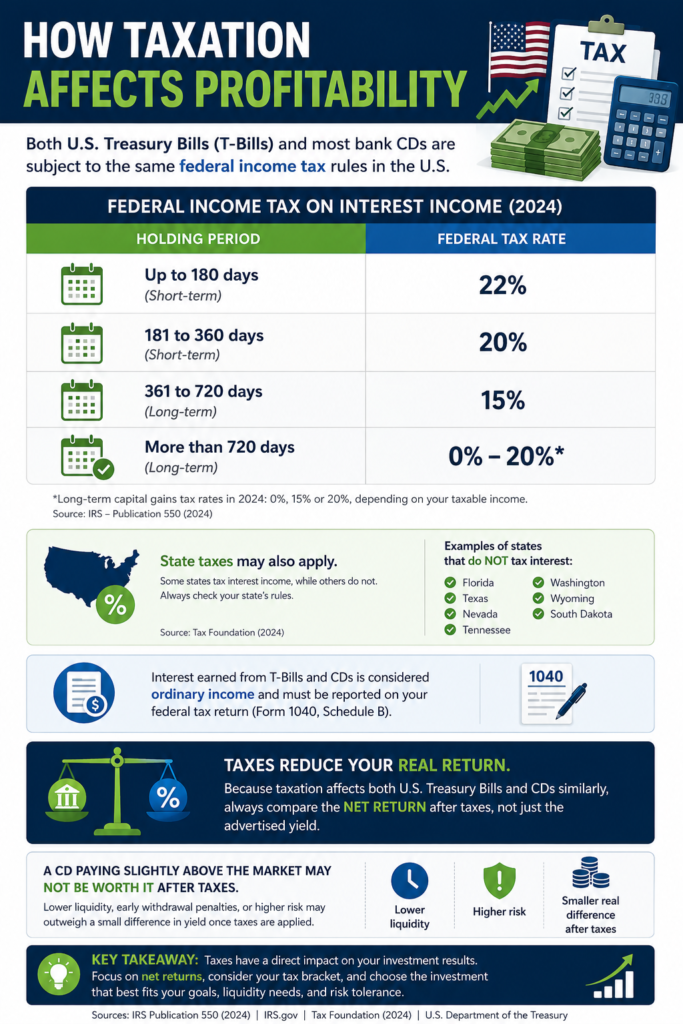
Ignoring fees and taxes
Custody fees, administration charges and taxation can erode gains over time.
Understanding these factors is more important than simply chasing the highest advertised return.
Treasury Selic or CDB?
For conservative investors focused on liquidity and stability, Treasury Selic remains one of the safest and most efficient choices during periods of high interest rates.
For investors seeking higher profitability and willing to accept slightly more complexity and risk, selected CDBs may deliver superior returns.
The most important point is understanding that avoiding losses is not only about maximizing returns. It also involves preserving liquidity, minimizing risks and aligning investments with real financial goals.
In many cases, the smartest strategy is not choosing one over the other, but using both intelligently within a diversified conservative portfolio.

Related content
See how to prioritize your bills
Discover the smartest way to prioritize payments and protect your essential expenses first.
Keep reading * You will remain on the current websiteFAQ — Treasury Selic or CDB
Yes. Treasury Selic is backed by the Brazilian federal government, while CDBs depend on the issuing bank’s financial strength.
Small temporary losses can happen if you redeem early due to mark-to-market effects, although Treasury Selic is considered low volatility.
Many CDBs are protected by the FGC up to current coverage limits per institution and investor.
Some CDBs paying above 100% of CDI may outperform Treasury Selic, especially during elevated interest rate cycles.
Treasury Selic is usually preferred because of liquidity, stability and government backing.